SkyComm: Rethinking in-flight announcements as inclusive communication
Project
UX Case Study
Role
UX Researcher

Disclaimer
This is a research-led UX case study. There are no high-fidelity screens, no UI designs, and no usability testing conducted. I did not have access to planes, airline infrastructure, or real flight environments.
SkyComm reflects my interpretation of a real-world problem using research that is publicly available today. This case study documents how I encountered the problem, how I explored whether it had already been addressed, what existing research covers well, where gaps remain, and how I reframed the problem based on that understanding.
Storytime
I was on a flight recently when an announcement came on. Between the cabin noise and the constant hum of the plane, I couldn’t fully hear what was being said. I looked at the screen in front of me to see if there was more context.
It just said “Announcement.”
There were no subtitles, no summary, and no way to check what I had missed.
That moment stayed with me because announcements aren’t just background noise. They’re often where safety instructions, timing updates, and reassurance live. And yet, if you miss them once, there’s usually no way back.
Background
In-flight entertainment systems have advanced significantly. Screens are now standard, accessibility guidelines are increasingly referenced, and features such as captions, adjustable text, and alternative audio options are more common than they were a decade ago.
However, announcements have not evolved at the same pace. They are still delivered primarily as one-time, audio-first events. If a passenger misses the announcement at that moment, the information is often gone. Research on attention and recall in aviation environments shows that noise, fatigue, anxiety, and divided attention all reduce comprehension, even for well-designed messages.
Type of Users
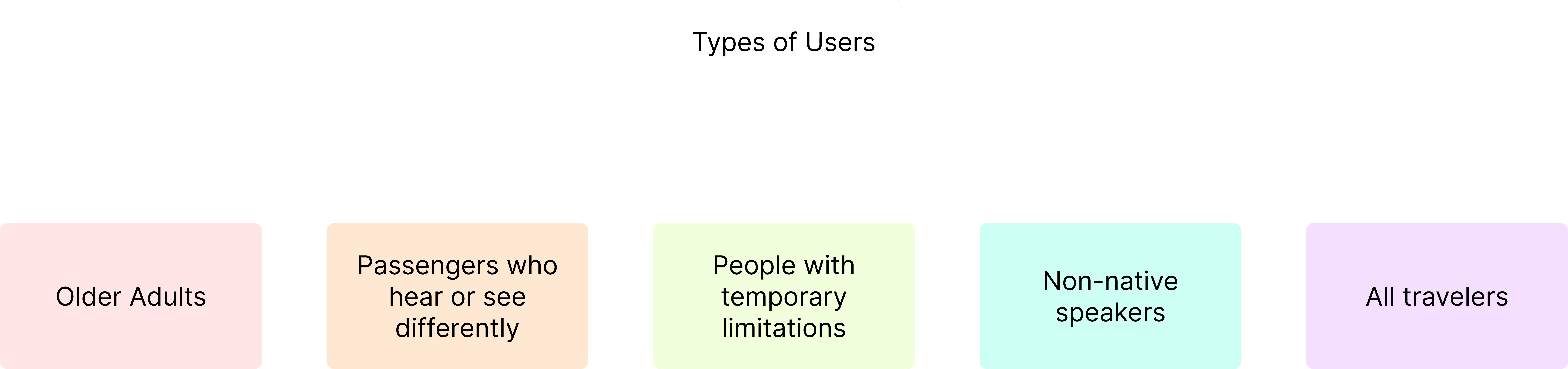
older adults experiencing natural changes in hearing or vision
people who hear or see differently or use assistive tools
passengers with temporary limitations such as fatigue, migraines, anxiety, ear pressure, or sensory overload
non-native speakers processing speech in noisy environments
Anyone wearing headphones, resting, distracted, or simply not looking at the screen at the right moment
Accessibility here is situational. Most people will experience barriers at some point, even if they do not identify as having a disability.
Problem statement
In-flight announcements are delivered as single-moment, audio-first events in a noisy and distracting environment, making critical information easy to miss and difficult to revisit.
Existing research
Before proposing any solution, I reviewed academic and policy research related to in-flight announcements, accessibility in aviation, and in-flight entertainment systems.
Research focused on announcement accessibility within IFE systems shows that accessibility improves when announcements are transcribed, visually clear, and remain visible until passengers dismiss them. These changes reduce confusion and improve comfort for passengers who rely on screens.
Other research explores non-visual interaction with IFE systems, including audio output and haptic feedback. These studies demonstrate that alternative sensory channels can support access, but they also emphasize that poorly designed feedback can increase cognitive load.
Additional studies examine how passengers process safety information and how easily attention and recall break down, even when content is well designed. Policy and legal research further shows that aviation accessibility often emphasizes assistance from staff rather than independent access to information systems.
Together, this research confirms that announcements are a real accessibility challenge and that communication quality affects both safety and emotional experience during travel.
The gap that still exists
Across the research, in-flight announcements are still treated in limited ways. They are framed as moments that happen once, messages that depend entirely on attention and timing, and information delivered primarily through a single channel.
Even when text is available, it often assumes the passenger is looking at the screen at the exact right moment. What’s missing is a shift in how announcements are framed.
Announcements are not just sounds. They are information. And like any important information, they should be noticeable even when attention is elsewhere, understandable through more than one sense, and recoverable after the moment has passed. No single study fully reframes announcements in this way.
Question
How might in-flight announcements be designed as multi-sensory, passenger-controlled, and revisitable information, so critical updates are not lost to noise, distraction, or sensory mismatch?
This question builds on existing research rather than replacing it, reframing the problem at a system level.
Path to Solution
Introducing wearables or tactile cues
Most existing solutions focus on improving how announcements appear once a passenger is already paying attention. Aircraft cabins place heavy demands on sight and hearing. Noise, screens, lighting, and fatigue all compete for attention. Adding more visual or audio information does not guarantee it will be noticed.
Research in accessibility and human factors shows that distributing information across sensory channels can reduce reliance on any one channel. While haptic and tactile feedback have been explored in other contexts, none of the reviewed research applies wearables or tactile cues specifically to in-flight announcements as a way to support awareness.
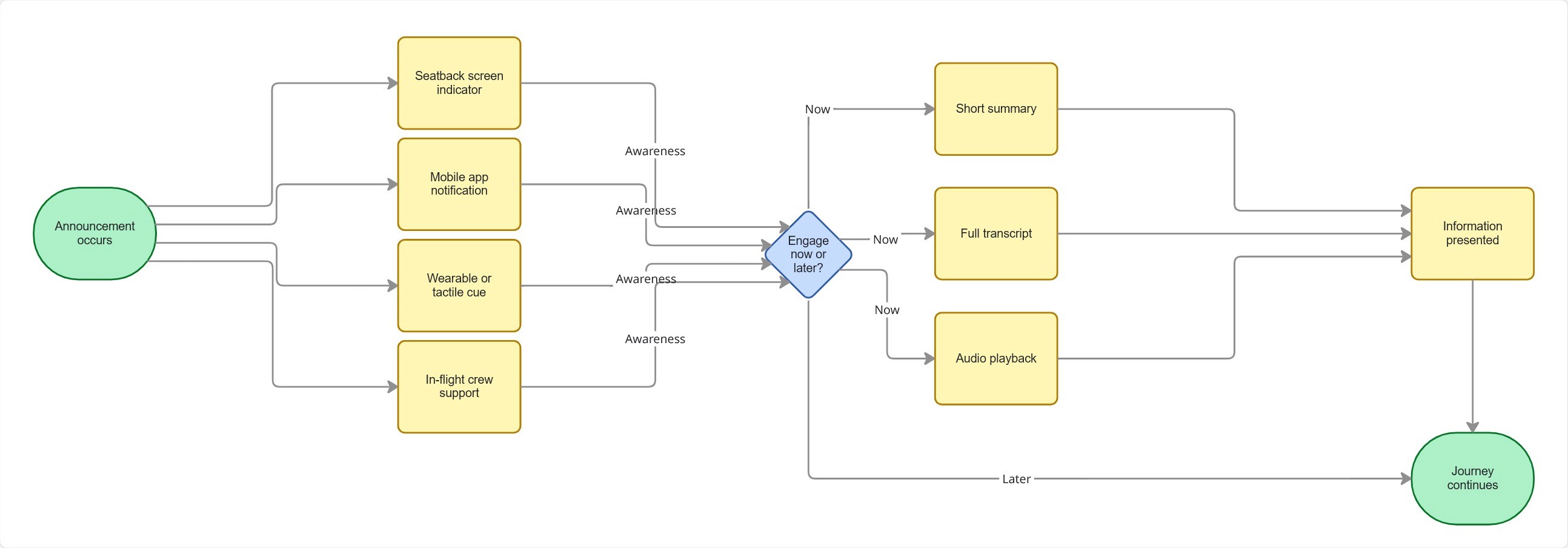
SkyComm introduces wearables and tactile cues not as content carriers, but as awareness signals. It could be a brief vibration from a smartwatch, a mobile device, an airline-provided wearable, or a seat-installed tactile cue that does not communicate the announcement itself. It simply signals that information is available.
The three layers
The core idea is simple: important information should not rely on a single sense or a single moment. To support that idea, SkyComm is built around three layers:
Awareness
When an announcement occurs, passengers receive a subtle awareness signal through their chosen channel. This may be visual, auditory, or tactile. Wearables and seat-based tactile cues are proposed here as optional mechanisms to support awareness when passengers are resting, distracted, or not looking at a screen
Understanding
Once aware, passengers can access a readable summary or transcript when they choose. Presentation can adapt to different needs, such as larger text or clearer contrast, building on findings from existing IFE accessibility research.
Recovery
Announcements are stored in a Recent Announcements space. Passengers can revisit what they missed instead of guessing, relying on companions, or seeking staff assistance.
This directly addresses the fragility of one-time announcement delivery identified in the literature.
User flow
Limitations
This case study does not include usability testing. Meaningful evaluation would require controlled environments to simulate cabin noise, participants with varied sensory and linguistic needs, careful measurement of cognitive load and recall, and access to real or simulated aircraft systems.
Initial testing would need to occur in controlled lab settings before any in-flight evaluation could be ethical or feasible. SkyComm should be understood as a research-informed proposal, not a validated solution.
Keypoints
SkyComm does not claim that captions, transcripts, or accessibility features are new.
Its contribution lies in how the problem is framed and how existing ideas are combined.
Instead of asking how to make announcements clearer, SkyComm asks how to make announcements hard to miss.
By introducing optional wearable and tactile awareness cues and pairing them with revisitable information, SkyComm addresses a moment that existing research leaves largely untouched: when information exists, but attention does not.
Future Scope
This case study started with a simple moment. A screen that said “Announcement” but did not help me understand what was said.
Research shows that announcements matter for safety and comfort, and that attention in flight is fragile. SkyComm is my attempt to respond to that reality, not with a polished interface, but with a more resilient way of thinking about communication.